| | |
Get Quote
Home / Guides & Insights / Retrofit Guide

Fixed-Pitch to Variable: When to Retrofit Your Hydropower Turbines

Dry-season losses, a changing grid, ageing runners, leaking oil systems — how converting fixed-pitch runners to variable pitch adds 5–15% generation, and how to decide whether your plant is a candidate.

011. Four signs your plant is losing money

  • Generation drops in the dry season. A fixed-pitch runner is optimised for one flow. When the river runs lower, the blade angle can no longer follow, efficiency collapses and you spill water you could have used.
  • The grid (or your load) changed since commissioning. More village loads, a new industrial customer, or interconnection with a larger grid means the plant must follow demand — something a fixed-pitch machine does poorly.
  • Your pitch or guide-vane system leaks oil. Traditional blade-control systems use pressurised oil. Leaks mean maintenance, environmental risk on a river, and lost running hours.
  • The unit is ageing and due for a major overhaul anyway. If the runner or seals need work, combining the overhaul with a pitch conversion costs only a fraction of a separate later project.
Rule of thumb: if your plant runs on a strongly seasonal river, operates below rated output for more than a few months each year, or has an oil-based pitch system with recurring leaks — a conversion study almost always pays for itself.
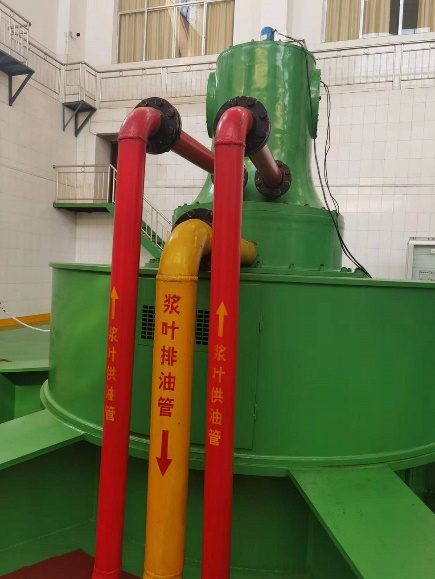
Oil pollution from traditional blade pitch systems in hydropower plants

022. What the conversion involves

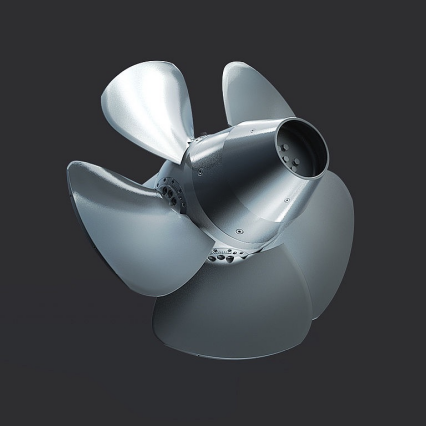
Converting fixed-pitch (propeller or fixed-blade Kaplan) runners to variable pitch adds a controlled blade mechanism so the unit can adjust its angle to flow and head in real time. On the machines we retrofit, this is delivered as a coordinated package:

  • TCH-RETROFIT-FP kit — new runner hub with the blade mechanism, upgraded guide-bearing area, and matching servomotors, engineered to the existing spiral casing and generator.
  • TCH-OFBP control — an oil-free blade-pitch actuation system that removes pressurised oil from the hub entirely: cleaner, lower maintenance, no oil in the river.
  • TCH-BPC 2000 controller — a PLC-based digital blade controller with a 7-inch touchscreen, Modbus/5G telemetry and one-button automatic operation for island or grid mode.
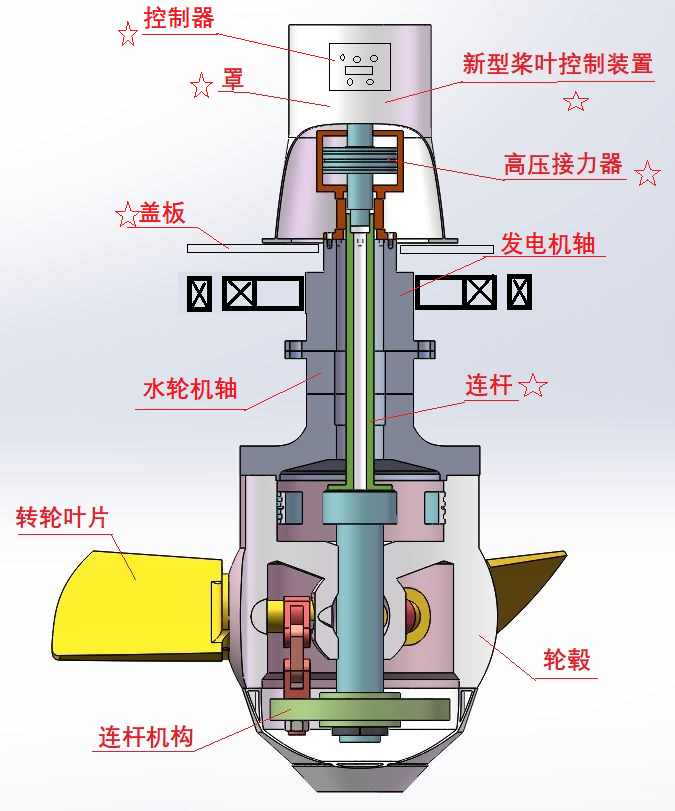
TCH-OFBP oil-free blade pitch control system cross-section

Cross-section of the TCH-OFBP oil-free blade-pitch control system.
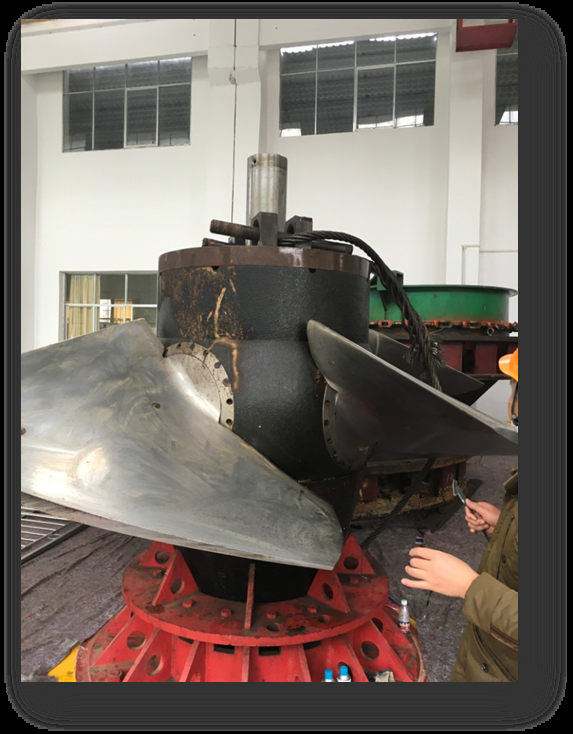
TCH-RETROFIT-FP fixed-to-variable pitch runner conversion kit

Fixed-to-variable pitch runner conversion — new hub and blade mechanism.
033. What owners typically gain

  • +5–15% annual generation on seasonal rivers, by recovering flow that a fixed blade angle cannot use.
  • Shorter outages — a kit engineered to the existing civil works installs in about 30 days on site when planned as a single shutdown.
  • Grid-friendly regulation — real-time blade control lets the plant hold frequency and voltage on an isolated grid, or follow dispatch on a connected one.
  • Lower maintenance and environmental risk — the oil-free option eliminates hub oil leaks, seal replacement cycles and the risk of oil reaching the river.

044. Field cases

  • Laos — 15 MW Kaplan plant. Seasonal Mekong tributary; conversion restored dry-season output and enabled automatic frequency control.
  • China — Enshi Tangkou, 11 MW × 4 units. Multi-unit modernization on a regulated river; the fleet now tracks load automatically.
  • China — Guangxi cluster, six stations. Standardized kits across similar machines cut engineering cost per station.
  • China — Fujian Gaohua & Hubei Jiefangshan. Single-unit conversions proving the payback on smaller machines.
Aerial view of a Laos Kaplan hydropower plant after fixed-to-variable pitch conversion

Aerial view of a Kaplan plant in Laos after conversion to variable pitch.

055. A 60-second self-check

  • Does your river’s flow vary strongly between seasons (more than roughly 2:1)?
  • Do you run below rated capacity for several months a year?
  • Does your pitch or guide-vane system use oil — with leaks or seal work on the maintenance schedule?
  • Is the unit due for a major overhaul within the next two years?
  • Would more dry-season energy help you serve new customers or replace diesel?
If you answered yes to two or more, a conversion study is worth the few weeks it takes. We screen candidates free — unit type, runner diameter, head and flow data are enough to start.

Common questions

How much extra generation can a retrofit really add?+
On a strongly seasonal river, owners typically gain 5–15% in annual energy after converting fixed-pitch runners to variable pitch. The gain depends on your flow-duration curve: the more months the plant runs below rated flow, the larger the benefit. We model this from your hydrology before you commit.
Which turbines can be converted?+
Fixed-pitch propeller, fixed-blade Kaplan and bulb units — where the hub has room for a blade mechanism and the existing spiral casing, generator and civil works can be retained. Each candidate needs a short engineering check of the hub space, shaft and bearing arrangement; that check is part of our free screening.
How long will the plant be out of service?+
With a kit engineered to your site, the conversion itself is typically done in about 30 days on site as a single planned shutdown. If the unit needs other major works (runner reconditioning, generator overhaul), we schedule them into the same window so you stop the plant once, not twice.
What is the difference between oil-free and conventional pitch control?+
Conventional variable-pitch hubs pressurise oil into the rotating hub to move the blades — effective, but seals wear, oil degrades, and leaks put oil into the powerhouse or the river. The TCH-OFBP approach actuates the blades without pressurised oil in the hub: fewer seals, longer service intervals and no oil pathway to the river. It is our default on retrofit projects.

Not sure if your units are candidates?

Send the unit type, runner diameter, head, flow data and a photo of the nameplate. Our engineers check the hub and drive train and tell you whether a conversion study is worthwhile — free, within 24 hours.

Ask About a Retrofit Study →
24/7 Engineer Chat
售前咨询 / Presales

TCHIER Presales Engineer

Hydropower & Renewable Energy
微电网智巡 / Microgrid
🔧

马达微电网智巡专家

Microgrid Smart Inspection